
 New! Website, brand book and mascot for a school in New York
The ChatGPT ads manager: how it works and what you need to know before launching
We go through it in order: where ads are shown, how a campaign is built, what limits the offer has to fit into, how much a click and an impression cost and what a company from Kazakhstan should consider separately. No promises of a “new golden channel”, only the structure and the numbers.

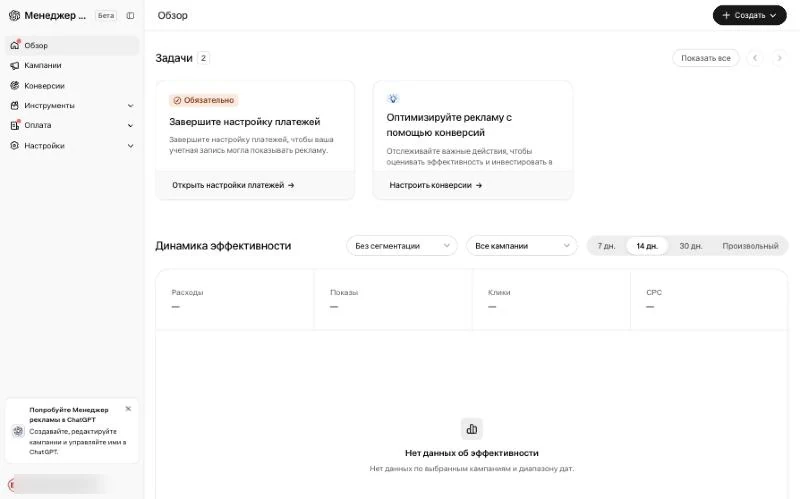
Where ads are shown and who sees them
Ads in ChatGPT are switched on country by country. In autumn 2026 impressions run in more than 30 countries of Europe, as well as in the United Kingdom, Mexico, Brazil, Japan and South Korea, and the list is growing. Ads are seen by users of the free plan: there are no ads on paid subscriptions.
The block appears at the end of an answer and leads to the advertiser’s website. This is a fundamentally different mechanic from search: a person does not compare a dozen ads, they get an answer to their question and next to it a single offer. Two consequences follow. First: competition for attention is lower. Second: a mistake in the offer costs more, because there will be no second chance in the same answer.
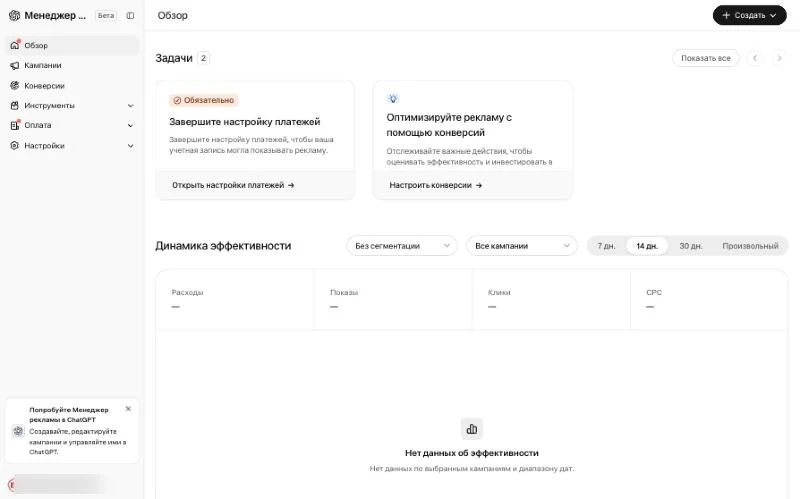
How the ads manager works
The structure is familiar to anyone who has worked with contextual advertising: campaign → group → ad. At the campaign level you choose the goal and the payment model, at the group level the bids and the maximum cost of a conversion, at the ad level the creative.
- Campaign goals
- CPM is payment per thousand impressions, CPC per click. Payment for conversions is announced as the next step
- Minimum budget
- $25 a day
- Account currency
- It is chosen once when creating the account and does not change afterwards. The list includes the dollar, the euro, the pound and the Kazakhstani tenge
- Product feed
- A separate format is the product carousel, suitable for online stores
- UTM tags
- The ads manager adds them itself: utm_source=chatgpt_ads&utm_campaign={campaign_id}
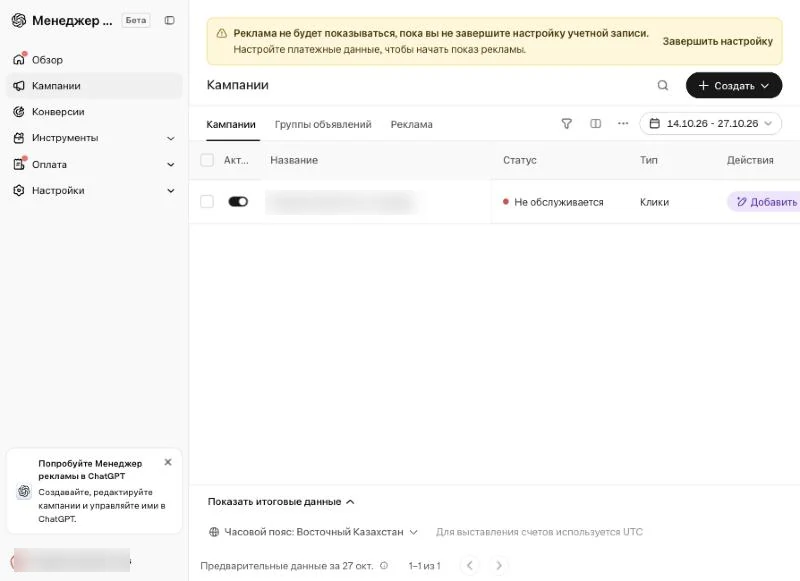
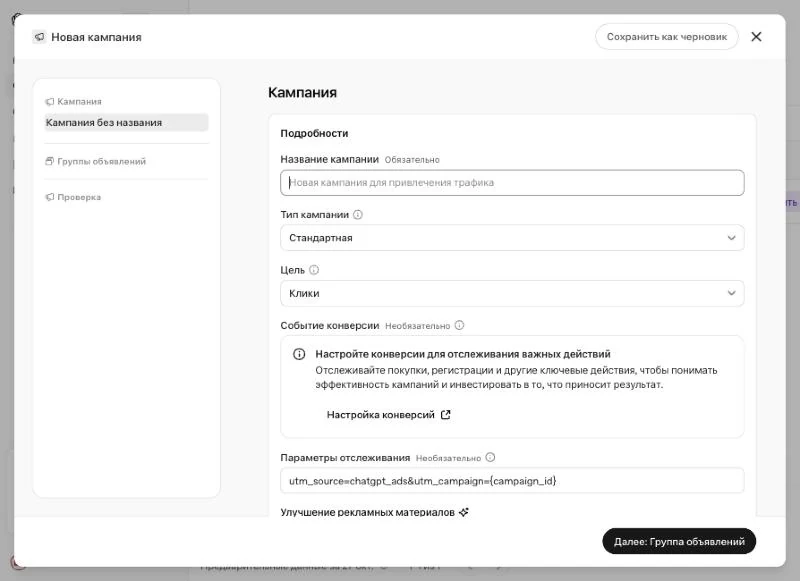
Two switches on this screen are worth noticing right away. The default bidding strategy is Autobid, that is, automatic. And “Ad enhancement” is switched on: the AI creates personalized and translated versions of your headlines and descriptions on its own, and they can be shown without your review. For brands with strict wording requirements this is the first thing to switch off.
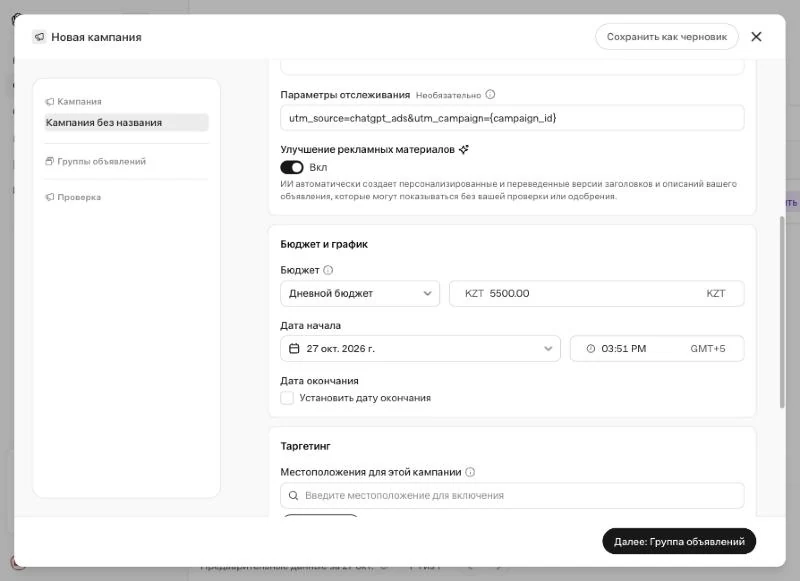
An important detail that is easy to miss: the currency is chosen once. If you make a mistake, expense reporting will have to be reconciled by hand, and accounting will get exchange-rate differences in every act.
Ad format: 50 and 100 characters
An ad consists of three elements, and the limits are strict:
- a logo: square, from 256×256 pixels;
- a headline: up to 50 characters;
- a description: up to 100 characters.
Fifty characters is about six words. They have to hold both the service and the reason to choose you. A common mistake is to spend the headline on the company name: in the dialogue the person has already received a recommendation, and they need specifics. Compare:
This does not work
Company LLP: the market leader
We have been on the market since 2008, an individual approach and flexible terms for each client
This is better
Car rental in Almaty without a deposit
Car delivery around the city, insurance included. Booking on WhatsApp.
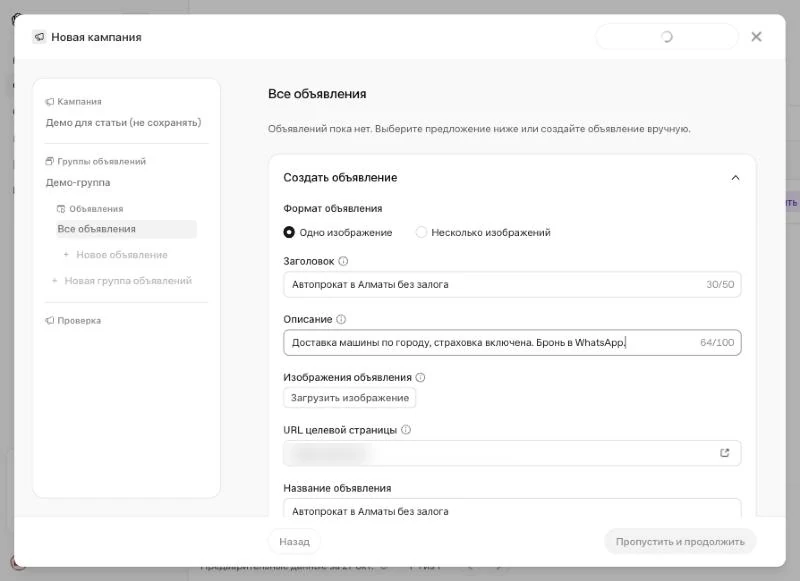
In the same place the ads manager offers recommended ads: variants that the AI builds from your campaign. They are handy as a draft, but checking is a must: it is the same AI that generates the translations that go into display without your approval. Before launch the ads manager shows a preview: check how the headline looks in one line on a phone, not only in the interface on a large screen.
Key phrases that are optional
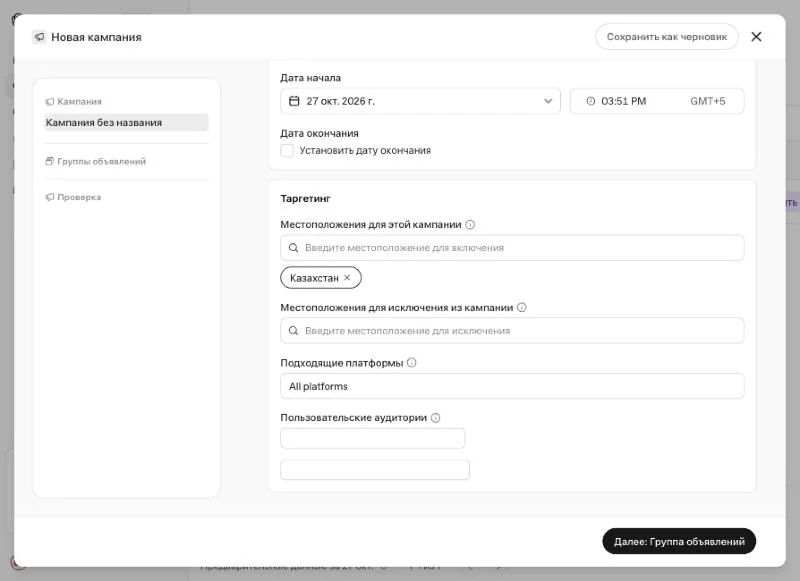
In the ads manager you can set key phrases, and this confuses those who came from contextual advertising. Here phrases are not a display rule but a hint to the algorithm: the matching goes by the meaning of the dialogue. So what you need to collect is not high-frequency queries but the wording with which a person comes for advice: “who to give it to”, “what to choose”, “is it worth it”, “how it differs”.
- “where to get a car without a deposit”
- “a weekend rental in Almaty”
- “what is better, a taxi or a car”
- “I need a car with delivery”
Different wording, one intention. The algorithm focuses on the meaning.
How much a click and an impression cost
Public guidelines for autumn 2026: CPM is about $60 per thousand impressions, the recommended cost per click is $3–5. The figures are market ones, not guaranteed: in a narrow niche a click can cost less, in a competitive one more.
Let us count honestly. At $4 per click a $600 budget is about 150 visits a month. If the website converts 5% of the traffic, that is 7–8 enquiries. For dentistry with an average bill of several hundred thousand tenge such economics add up, for a product at 5,000 ₸ they do not. This is the first thing to check before launch, not after.
Analytics: what to actually count
The ads manager shows impressions, clicks, spend, CPC, CTR and CPM, and there is also a button with AI insights. All of these are channel metrics, not business ones. To see requests you need to connect a pixel and conversion events (a website, iOS and Android apps are supported, and there is an API) and set goals on your side.
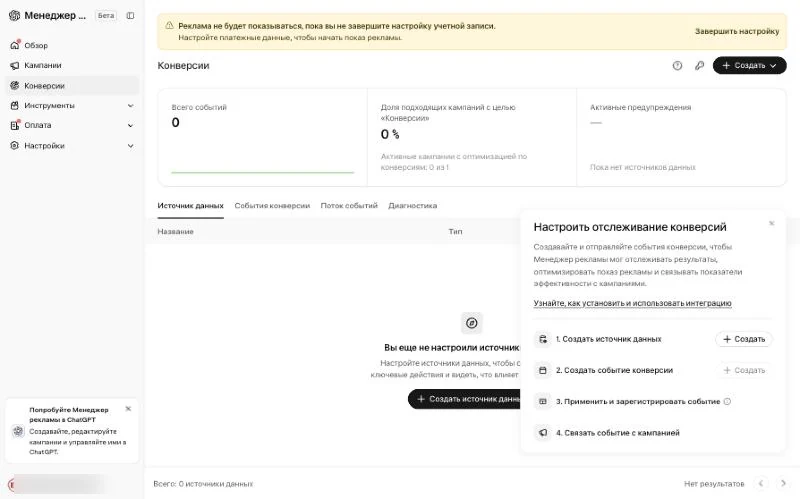
The practical minimum: a separate UTM tag per channel, a goal for form submission, a goal for a click on a messenger and call tracking if people call you. Without this, in a month you will be arguing about whether “people came” instead of counting the price of an enquiry.
What OpenAI itself promises
On the official advertising page OpenAI states its approach to advertising in three principles. They are worth knowing because they determine how an ad will look next to an answer:
- Clear labeling. Ads are marked as ads and are not disguised as part of the answer.
- Separate from the answers. An ad does not change the assistant’s answer itself and sits next to it.
- Choice and control. The user controls how their data is used for advertising.
In the same place OpenAI describes the launch in three steps: create a campaign with a budget and a goal, add the ad parameters manually or by bulk upload, launch and analyze the results. The first advertisers named are Newegg, Best Buy, Lowe’s and VistaPrint: the channel is being tested by large retailers, not only small players.
One more detail from the official materials: during the beta period the volume of impressions is deliberately limited and increased gradually. This explains why at the start the delivery goes slower than expected: it is not about the campaign settings.
What a company from Kazakhstan should consider
Technically there is access: an account is opened for a company, and the tenge can be chosen as the account currency. But then begins what most often makes people postpone the channel:
- paying a foreign service for advertising and exchange-rate differences in accounting;
- company verification and ad moderation;
- closing documents for accounting: they have to be obtained somehow for an expense that bypassed your cash desk;
- management: the format, the bids and the scenarios have to be tested by hand.
That is why some companies hand the channel to an agency: we manage campaigns from our own ad account, accept the budget in tenge to a current account and close the month with an act, an electronic invoice (ESF) and an expense report. How this works with us is on the page “ChatGPT advertising in Kazakhstan”; the price and the launch procedure are there too.
A checklist before launch
- Count the economics. A click price of $3–5 against your average bill and the website conversion.
- Check the geography. Where your audience is and whether impressions are switched on there.
- Choose the currency once. It cannot be changed afterwards.
- Collect wording, not keywords. Whole questions, the way a person asks them.
- Fit the offer into 50 and 100 characters. A company name is not an offer.
- Prepare the page. A person with a specific question should not land on the home page.
- Set goals and tags. Otherwise you will count clicks, not requests.
Frequently asked questions
Can you launch ads in ChatGPT from Kazakhstan?
Yes. The ads manager is available, an account can be opened for a company and the account currency chosen once: the Kazakhstani tenge is in the list. The difficulties begin not with access but with payment, verification and management, which is why some companies hand the channel to an agency.
How much money is needed to start?
The minimum daily budget in the ads manager is $25. But conclusions need statistics, so in practice it makes sense to plan from $600 a month for the advertising itself, not counting management work.
How does advertising in ChatGPT differ from contextual advertising in Google?
In Google the person chooses from a list of ads themselves. In ChatGPT the offer is built into the answer to their question, and the matching goes by the meaning of the dialogue, not by an exact match of keywords.
Can requests be counted instead of clicks?
Yes. The ads manager has a pixel and conversion events for websites and apps, plus an API. Tags and goals on the website side are mandatory: without them you will see only impressions, clicks and CTR.
Management is from 80,000 ₸ a month per campaign, the advertising budget from $600. A 15-minute call, a contract, launch in 5 business days. Details are on the service page.
Related services